
We could not have wished for a more beautiful day to go on a field trip to ASTRON's LOFAR (LOw Frequency ARray) antenna system. With a clear blue sky, chirping skylarks, sunshine and the pure seepage water of the Drenthe Hondsrug beneath our feet, the "Superterp" near Buinen was a pleasant place to be.
A group of 35 ICD colleagues and their family members were warmly welcomed by the expert guides of the Drentse Landschap who are members of the LOFARTafel foundation. These are guides who can tell you all about the beautiful nature as well as the high-tech systems of LOFAR.
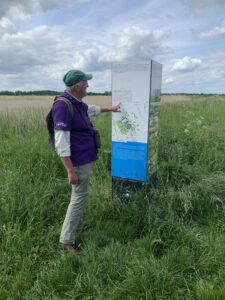


The Superterp is the high-tech heart of a large pan-European radio telescope. Together with stations in Sweden, Poland, Germany, England, France, Ireland and Latvia, it forms a radio telescope with a diameter of 2000 km. The LOFAR Superterp is located in the valley of the river Hunze and comprises most of the antenna systems.
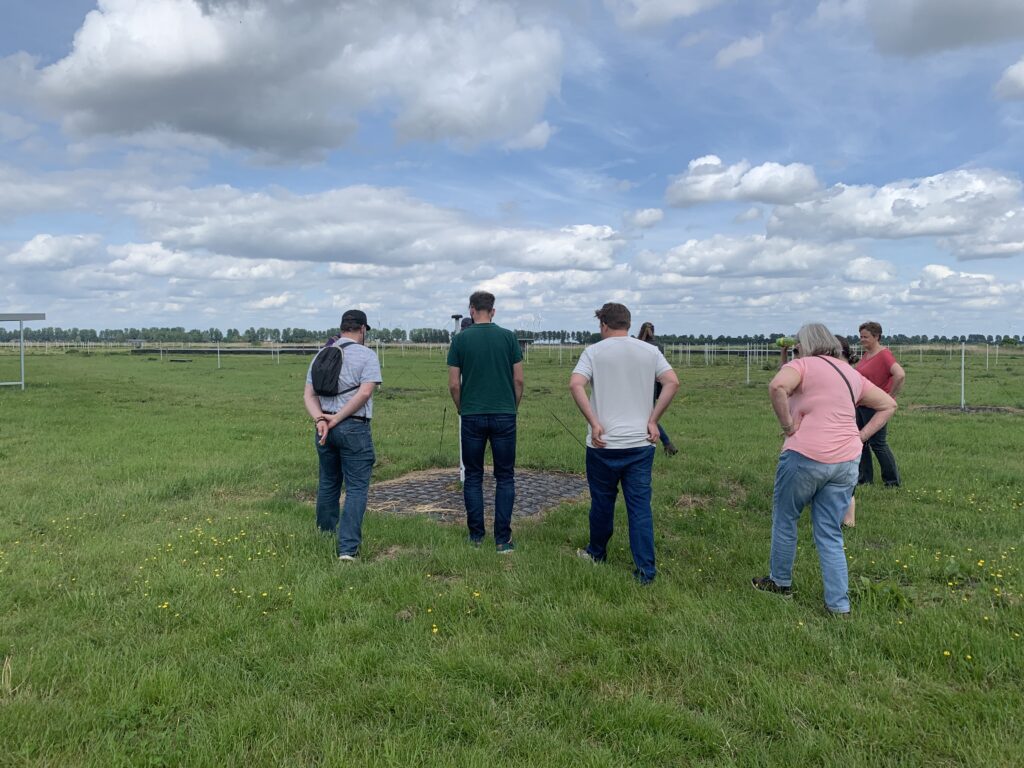

The systems can be divided into two categories: the antennas below the FM range and those above the FM range. The first type consists of two wires that are placed crosswise on top of each other. The second type consists of boxes where antennas and electronics form a whole. Viewed from close by, they appear to be mainly robust (weather and water) low tech systems.

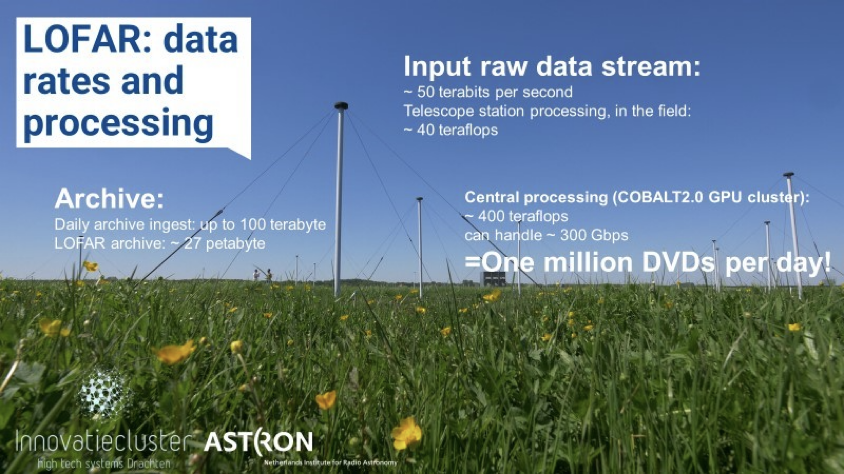
So where does the hightech come in? It is in the subsequent steps. All radio waves are converted into signals in the corresponding computer cabinets and tuned to exact (atomic clock) times, because the different types of antennas are located at different distances from this centre. This exact 'tuning' creates a full picture of (a part of) the universe. Because the location is in the open field, observations can be made almost to horizon level. The quantities of data are also staggering. Extra radiation from telephones, passing cars and other objects, such as windmills, can disturb the observations and are therefore excluded as much as possible.
The collected observations are sent to the computer centre on the RUG's Zernike Campus. From that moment on, astronomers all over the world can freely access ASTRON's data to do their specialist research. As the data are held at the Superterp for about 5-7 seconds, a kind of sky-photo can be taken (to be determined remotely) when astronomically interesting phenomena occur. Meanwhile, the LOFAR system is also used for research into meteorological phenomena, such as lightning.
Many thanks to Johan and Lonneke of ASTRON for organising a very interesting afternoon!