|

SRON discovers garbage dumps with large methane emissions using satellites

/
News / SRON discovers garbage dumps with large methane emissions using satellites

Using the Dutch space instrument Tropomi, the SRON methane research team identified methane emissions of 28 tons per hour at a garbage dump in Buenos Aires during a measurement in April 2021. In the various measurements, Buenos Aires, Delhi, Lahore and Mumbai stood out, because the emissions in those cities are on average twice as high as estimates based on worldwide inventories. Satellites are ideally suited to see where methane gas is leaking. Zooming in with the Canadian satellite GHGSat showed that a large part of the emissions comes from the garbage dumps in these cities. The emissions from the garbage dump in Buenos Aires amounts to a climate impact of one and a half million cars. With these discoveries, measures can be taken to combat climate change, for example by capturing or flaring the released methane.

Methane delivers after CO2 the largest share of the man-made greenhouse effect. This is due to its high Global Warming Potential (GWP-100): by weight, methane is almost thirty times more potent than CO2. “Methane only has a lifespan of about ten years in the atmosphere, so if we do something about the emissions now, we'll soon see the result in the form of less global warming. Of course, methane limitation alone is not enough, including CO2 we have to limit, but we can use it to slow down climate change,” says Bram Maasakkers, lead author at SRON. 
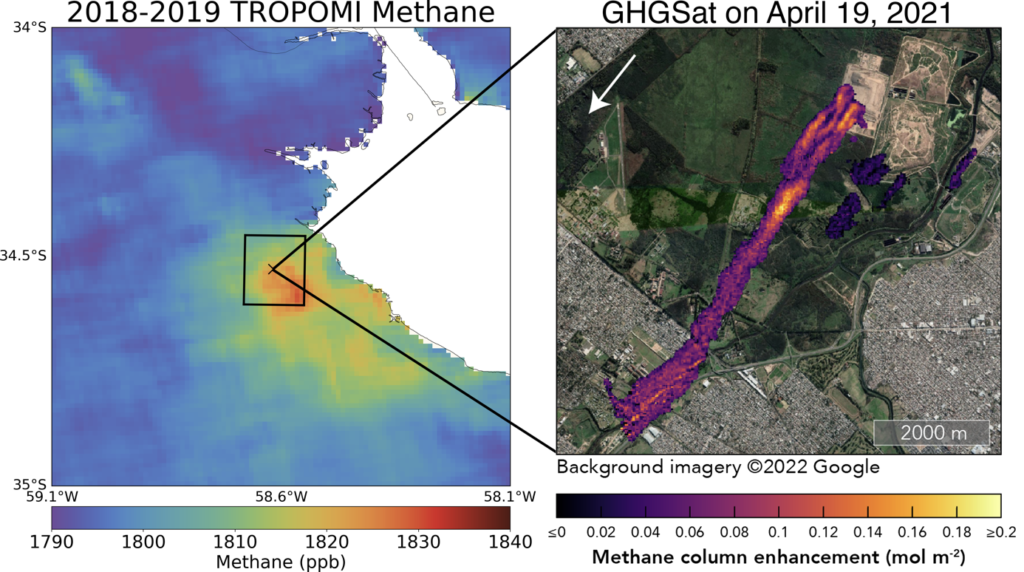


Left: Methane concentrations in 2018-2019 measured by Tropomi around Buenos Aires.
Right: Zoomed image by GHGsat satellite on April 19, 2021 showing methane plumes at the city center garbage dump. The white arrow indicates the wind direction.
Credit: SRON/GHGSat, contains Copernicus Sentinel data (2018–2019), processed by SRON.

Newsletter

Sign up and be the first to receive new vacancies.

An overview of

Our articles

An overview of

Our articles

High-tech manufacturing industry in Drachten: Trouw takes a look at Philips

ICD Knowledge Session High Tech Sensoring at Horus in Groningen: from 360-degree cameras to AI and autonomous systems

First Learning Day 3DPK 2030 brings latest developments in 3D printing to Drachten

From theory to practice: how an EngD accelerates innovation at Omnidots

Hilbrand Wijbenga and Roelof Jan Boer thanks for their years of dedication to the ICD

D66 parliamentary group visits Drachten: high-tech, accessibility, and broad prosperity take center stage

Hi!

Arjan Boerma thanks for more than two years of dedication to the ICD Safaris

Save the date: 1st Learning Day 3D Printkompas is coming!

ICD takes next step in sustainability with Environmental Impact Tool

Stijn Eikens and Stef Sillekens win ICD Student Award 2026 during inspiring final

AI is central to ICD's R&D knowledge session in Drachten

ICD celebrates 100th Steering Committee meeting at De Sluisfabriek

Looking for a job or internship in high tech? Discover the ICD Job Board!

UTwente Students Discover High-Tech Innovation During ICD Safari

Mikrocentrum opens training location for technicians on Campus in Drachten

ICD Presents High-Tech Opportunities During Semicon Day in Groningen

ICD Focus Group High Tech Sensing Visits ASTRON and NOVA in Dwingeloo

NHL Stenden students discover robotics during ICD Safari in Drachten

TU Delft students discover high-tech innovation during ICD Safari

ICT Safari for NHL Stenden Students: Embedded Applications in Practice

Innovate Together at ICD: Inspiration, Technology, and Collaboration in Drachten

HR knowledge circle ICD: insight into generational differences and informal care grows

Newsletter

Sign up and receive
be the first to see new job openings.

  • © 2026 ICD - Innovatiecluster Drachten
  • Website by Multiplus and BO. Be Original